Shipyard Hull Construction Line
Steel pretreatment and NC cutting are already automated, but line heating, block welding, painting, pipe outfitting, and inspection still rely on people, and the shipbuilding workforce keeps shrinking. The big advantage: portable welding robots and quadruped robots can be carried straight into the tight block compartments where people have always worked.
20 tasks across 7 steps can move to robots.
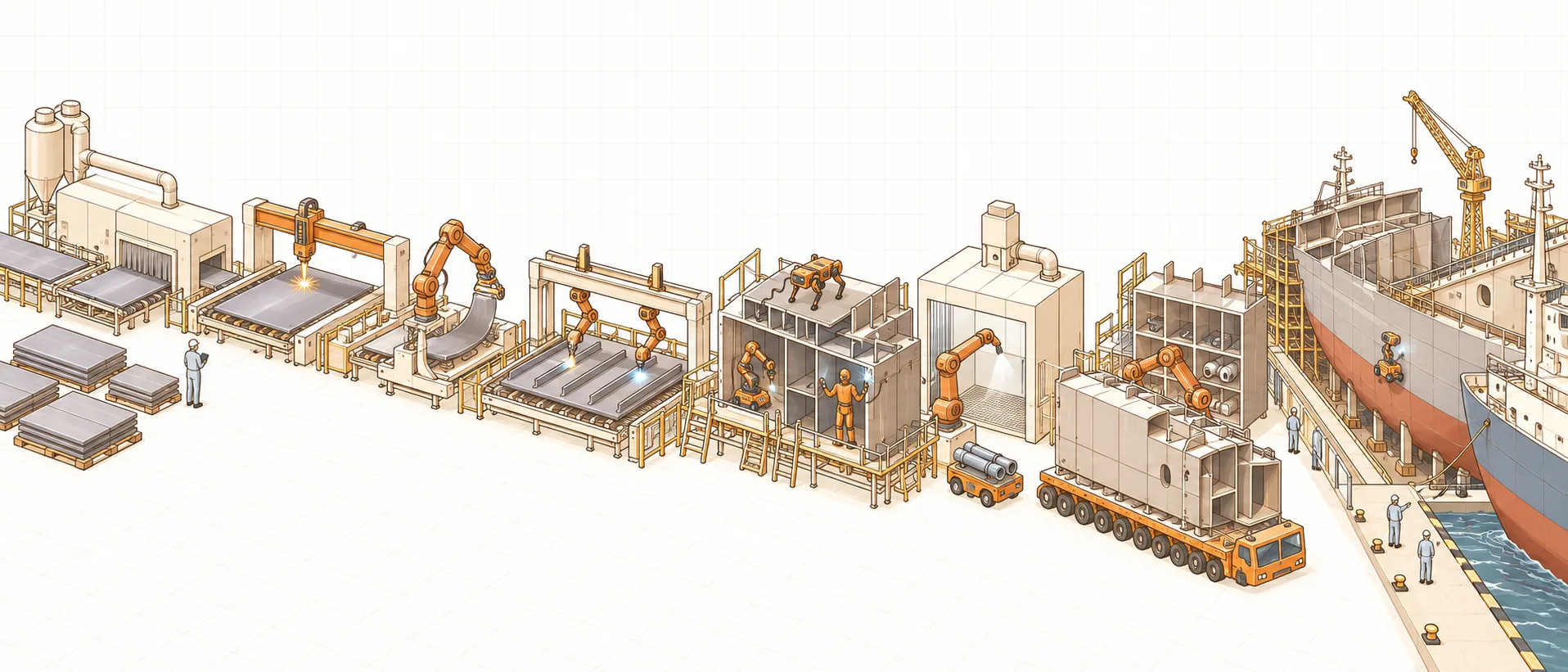
Process flow
Select a step to jump to its tasks.
- 1Steel intake
- 2Cut & bend2 tasks
- 3Sub-assembly2 tasks
- 4Block assembly7 tasks
- 5Painting4 tasks
- 6Outfitting2 tasks
- 7Erection1 task
- 8Inspection2 tasks
- 9Launch & trials
Process sources: 国土交通省 九州運輸局「船ができるまで」 / 国土交通省 海事局 気仙沼市 社会科指導案「船ができるまで」14 工程 / 日本造船工業会 塗装小委員会「造船業における塗装作業について」(2004) / ニュースイッチ「造船倍増、カギはロボット活用」(2026-05-11)
Tasks by step
For each step, the tasks people do today that robots already handle somewhere. Follow the link to candidate robots and proven deployments.
- Equipment
Steel receiving & pretreatment
Receive, store, and sort plates and sections from the mill, then shot-blast them and apply shop primer in the blast shop.
Shot blasting and primer coating run on a continuous line; plate handling by crane and magnet is part of that equipment.
- Robot-ready
Cutting & bending
NC gas or plasma cutters cut parts from design data. Curved shell plates are bent by skilled workers using line heating (gas torch plus water cooling).
- Line heating of curved shell plates: deciding heating lines and running the torch
Japan Marine United Tsu Works (Mie): small line-heating robots developed with Osaka Metropolitan University under NEDO went into operation (Oct 2024). Two robots on a 10 m plate, accuracy within 1 cm, expanding to four in FY2024.
Source: ニュースイッチ (2024-10-04)
- Replacing line heating at multiple yards with a production-model AI bending robot
Selected under MLIT's AI next-generation shipyard program (Mar 19, 2026): JMU, Osaka Metropolitan University, Kyokuyo Shipyard, Shin Kurushima Sanoyas, and Higaki Shipbuilding will field-test a production-model AI bending robot that computes heating spots instantly at several yards.
Source: 国土交通省 報道発表 (2026-03-19) / 国土交通省 採択事業リスト(別紙2)
- Robot-ready
Sub-assembly welding
Tack longitudinals and frames onto flat plates and weld them into sub-assemblies of a few tons. Since shapes rarely repeat, people handle fixturing, positioning, and welding.
- Simultaneous fillet welding of sub-assemblies by multiple industrial robots
HD Hyundai Samho (Yeongam, Korea): from Oct 2022, six industrial robots weld sub-assemblies simultaneously, using GMAW to reduce slag.
Source: The Korea Times (2023-01-24)
- Auto-generating robot instructions from 3D design data and coordinating several welding robots by AI on flat-panel parts
Imabari Shipbuilding Marugame (Kagawa): under the i-Shipping subsidy, an "automatic welding robot coordination system" that generates instructions from 3D data and pairs robots with portable carriers so people no longer move them (MLIT maritime report; development stage).
Source: 国土交通省 海事レポート 事例「今治造船」
- Robot-ready
Mid & grand block assembly
Combine sub-assemblies into blocks of tens of tons; people weld inside tight compartments, at height, and on curved surfaces, and attach lifting lugs.
- Welding short seams inside blocks with portable welding robots carried by hand
Shin Kurushima Dockyard (Imabari, Ehime) installed the first System LSI compact welding robot for shipbuilding (May 28, 2026): 15 kg, camera-and-laser seam detection, one operator per three robots, six more in FY2026. Products: Kobelco Ishimatsu (about 6 kg, rail-guided, magnet-fixed), FANUC CRX-3iA (11 kg, no teaching), Daido x Daihen cobot on a lifter cart.
Source: ニュースイッチ (2026-05-22) / ニュースイッチ (2026-05-11) / MONOist 神戸製鋼 大組立向け溶接ロボット (2017-10-24)
- Rail-mounted welding cobots compute weld positions from drawings and weld blocks without manual repositioning
HD Hyundai Heavy Industries Ulsan medium-ship division (Korea): cobots on self-propelled electric rails read drawings and weld (reported Jun 2026); moving from 2 to 6 robots per worker, target 8. HD Hyundai Robotics won an ArcLift GO order for four Chouest Group yards (May 2026, 2–3 robots per operator).
Source: Asia Economy (2026-06-14) / Marine Insight (2026-05-11)
- Replacing welding in confined compartments with lightweight welding robots to offset the welder shortage
Hanwha Ocean Okpo yard (Geoje, Korea): about 110 welding robots at 8 kg plus four 17 kg units for confined areas (Oct 2023). 67% of indoor welding is AI-assisted, targeting 100% by 2030; proven robots move to Hanwha Philly Shipyard (US) in 2026.
Source: KED Global (2023-10-30) / Hanwha Feature Story (2026-07-21)
- Magnetic-footed quadrupeds walk through dense longitudinals and along walls and ceilings to weld
Samsung Heavy Industries Geoje (Korea) x DIDEN Robotics (KAIST spin-off): the magnetic-footed quadruped DIDEN 3.0 crawled between longitudinals and welded with a back-mounted torch in tests; sales contract signed Sep 30, 2025, delivery for welding, inspection, and painting in H2 2026.
Source: DIDEN Robotics: Spider 30 (2026-04-09) / Cyprus Shipping News (2025-10-06) / Samsung Heavy Industries × Rainbow Robotics (2025-10-24)
- Legged robots that cling by electromagnet climb block exteriors to weld, paint, and verify quality at height and on curves
Kawasaki Heavy Industries Sakaide Works (Kagawa) unveiled a four-legged prototype (60 x 44 x 29 cm) that clings to hulls by electromagnet (Oct 6, 2026); cameras read seams and set weld volume. Demonstration at Sakaide in 2027, practical use targeted for 2028. With Namura and Shin Kurushima under MLIT's open-space AI welding/painting robot project (Mar 2026–Mar 2027, ClassNK and ABS evaluating); a separate MTI/JMU/Namura/Shin Kurushima project covers legged robots for closed spaces.
Source: Marine Insight (2026-10) / NHK (2026-10-06) / Baird Maritime (2026-10-08) / 国土交通省 採択事業リスト(別紙2)
- Humanoids trained on veteran welders' motions take over block welding
HD KSOE and HD Hyundai Robotics x Persona AI (Houston): after a May 2025 MoU, prototype feasibility was confirmed and a joint development agreement signed (Mar 23, 2026); prototypes by end-2026, field tests and commercialization from 2027. HD Hyundai Samho also agreed with NEURA Robotics (Germany) to test quadrupeds and humanoids for welding, logistics, and inspection (Jul 2025). Company announcements only.
Source: The Maritime Executive (2026-03) / Korea JoongAng Daily (2026-03-23) / Inspenet (2025-07-08)
- Cutting lifting lugs, welding them with robot arms, and moving finished lugs onward by AMR
HD Hyundai Heavy Industries Ulsan autonomous lug plant (Korea): industrial robot arms recognize weld seams and weld the lugs, while AMRs separately carry finished lugs onward (reported Jun 2026). 43 lug types covering 95% of usage; previously six workers made about 100 a day. The linked scene covers the AMR transport portion.
Source: Asia Economy (2026-06-14) / NewsPim 現地取材・溶接/再生工程写真 (2026-06-14)
- Robot-ready
Blasting & painting
Blast and grind weld seams and rust on blocks, then apply multiple coats of anticorrosive and antifouling paint. 85% is done outdoors, much of it at height or in closed compartments.
- Cleaning and grinding ship compartments with an autonomous mobility unit that detects obstacles
Shin Kurushima Dockyard, Toyota Motor, Imabari Shipbuilding, and Shin Kurushima Toyohashi: "AI onboard cleaning and grinding mobility" project selected under MLIT's AI shipbuilding-robot program (Mar 19, 2026), aimed at labor shortages in car-carrier construction.
Source: 国土交通省 報道発表 (2026-03-19) / 国土交通省 採択事業リスト(別紙2)
- Removing coatings and rust with a cobot carrying a laser and image-recognition AI
Sanwa Dock, Onomichi Dockyard, Hiroshima University, Nakata Mac, and ClassNK: pulsed-laser automatic hull surface treatment (MLIT selection, Mar 19, 2026, for newbuilding and repair). Product: FANUC CRX-3iA strips paint by laser, paired with a lift for ship-repair coating removal.
Source: 国土交通省 採択事業リスト(別紙2) / ニュースイッチ (2026-05-11)
- Replacing painting at height with AI painting robots under multi-robot fleet control
Daido, Manabe Zoki, Yaskawa, Asakawa Shipbuilding, JMU, and Shin Kurushima Dockyard: "AI fleet control x cobots" shipbuilding DX project (MLIT selection, Mar 19, 2026) developing unattended wheeled AI welding robots and AI painting robots for work at height, controlling several at once; Daihen and FANUC among partners.
Source: 国土交通省 採択事業リスト(別紙2)
- Hull washing, blasting, and painting by mobile robots (adjacent case from repair yards)
Damen Shiprepair Dunkerque (France, repair, adjacent case) received five AMBPR GreenDock Robot systems (Feb 2025): 400 bar washing, 2,500 bar UHP blasting, painting at 100 m²/h, enclosed overspray control and remote operation. RobotPlusPlus delivered 20-plus HighMate hydroblasting robots and supporting systems to NOSCO Shipyard (Vietnam) in April 2026; exact delivered models are unconfirmed.
Source: Damen (2025-02) / RobotPlusPlus 発表 (2026-05-07) / ShipUniverse (2026-10-16)
- Robot-ready
Outfitting (piping, electrical, pre-outfitting)
Fabricate pipe spools (elbows, tees, and flanges welded into units) in the shop and pre-fit them at block stage; cable pulling, machinery, and interiors follow at the quay.
- Robotizing alignment, welding, and measurement of pipe spools in the pipe shop
Samsung Heavy Industries Pipe RoboFab (Haman, Korea, completed Mar 16, 2026): 6,500 m², about 100,000 pipe spools a year, with design integration, automated logistics, machining, alignment, and welding run by vision AI. Hanwha Ocean Geoje cut prep work 60% with a pipe-welding cobot (Oct 2023).
Source: Asia Economy (2026-03-16) / The Korea Times (2023-10-14)
- Moving outfitting parts and materials around the yard by AMR
HD Hyundai Samho x LG CNS x HD Hyundai Robotics x HD KSOE (MoU Sep 15, 2025): developing an AMR-based automated logistics system for the yard plus humanoids for measurement, forming, and welding, targeting welding, assembly, outfitting, and inspection.
- Robot-ready
Block erection (dock)
Carry painted, pre-outfitted blocks to the dock on transporters, lift them in by goliath crane, and weld them together. Imabari's new dock has three 1,330 t cranes.
- Replacing transporter driving for super-large blocks between assembly stages and the dock with autonomous transporters
Hyundai Movex leads a Korean MOTIE project on intelligent autonomous transporters for super-large blocks (announced Jul 28, 2026; 42 months; KRW 19 billion), with Samsung Heavy, HD Hyundai Heavy, HD KSOE, and Hanwha Ocean, to be demonstrated at a US shipyard.
Source: Hyundai Group (2026-07-28) / Asia Economy (2026-07-28)
- Robot-ready
Inspection (welds, coatings, compartments)
Visual and NDT checks of weld beads, coating-thickness measurement, and visual inspection inside tanks and holds, done by yard and class surveyors from scaffolds and lifts.
- Judging weld-bead quality right after welding with AI integrated into the welding robot
CSBC (Taiwan) x Techman Robot (Dec 2025): the TM6S cobot (1.8 m reach, 6 kg payload) locates weld points by vision and an integrated AI inspects weld quality; demonstration line running, mass-production tests the following year. In Japan, Kyushu University, Hiroshima University, ClassNK, Kobe Steel, Oshima Shipbuilding, Tsuneishi and others are developing weld-log auto-judgment and a quality-verification guideline draft (MLIT selection, Mar 2026).
Source: Taiwan News (2025-12-19) / 国土交通省 採択事業リスト(別紙2)
- Replacing scaffold inspection inside tanks and holds with drone visual checks and thickness gauging (adjacent case on ships in service)
Terra Drone's UT Drone gained class-society certification for ultrasonic thickness gauging in ship inspection (Oct 2022, announced as a world first), targeting one-tenth the cost and effort of scaffolds and lifts. ClassNK published drone guidelines for class surveys (Apr 2018, flight tests in tanks and holds); DNV GL inspected a 19.4 m FPSO tank with the indoor Scout 137 drone (2020). No confirmed use at Japanese yards for newbuilding surveys yet.
Source: Terra Drone (2022-06-02) / LOGISTICS TODAY (2022-10-07) / IIMS ClassNK drone guidelines (2018-04-10) / DRONE.jp (2020-07-06)
- People
Launch, sea trials & delivery
Flood the dock to launch, finish outfitting and final painting at the quay, verify performance in sea trials, and deliver to the owner.
Launch and sea trials require owner, class, and yard witnesses and operational judgment. Hanwha Ocean has onshore engineers diagnose remotely during trials, but this is not robot work.
Summary
| Step | Robot-ready task | Stage | Robot type | Use-case guide |
|---|---|---|---|---|
| 2. Cutting & bending | Line heating of curved shell plates: deciding heating lines and running the torch | In use in Japan | Robot Arm | Assembly & Processing |
| 2. Cutting & bending | Replacing line heating at multiple yards with a production-model AI bending robot | PoC stage | Robot Arm | Assembly & Processing |
| 3. Sub-assembly welding | Simultaneous fillet welding of sub-assemblies by multiple industrial robots | Proven overseas | Robot Arm | Assembly & Processing |
| 3. Sub-assembly welding | Auto-generating robot instructions from 3D design data and coordinating several welding robots by AI on flat-panel parts | PoC stage | Robot Arm | Assembly & Processing |
| 4. Mid & grand block assembly | Welding short seams inside blocks with portable welding robots carried by hand | In use in Japan | Robot Arm | Assembly & Processing |
| 4. Mid & grand block assembly | Rail-mounted welding cobots compute weld positions from drawings and weld blocks without manual repositioning | Proven overseas | Robot Arm | Assembly & Processing |
| 4. Mid & grand block assembly | Replacing welding in confined compartments with lightweight welding robots to offset the welder shortage | Proven overseas | Robot Arm | Assembly & Processing |
| 4. Mid & grand block assembly | Magnetic-footed quadrupeds walk through dense longitudinals and along walls and ceilings to weld | PoC stage | Quadruped Robot | Assembly & Processing |
| 4. Mid & grand block assembly | Legged robots that cling by electromagnet climb block exteriors to weld, paint, and verify quality at height and on curves | PoC stage | Quadruped Robot | Assembly & Processing |
| 4. Mid & grand block assembly | Humanoids trained on veteran welders' motions take over block welding | PoC stage | Humanoid | Assembly & Processing |
| 4. Mid & grand block assembly | Cutting lifting lugs, welding them with robot arms, and moving finished lugs onward by AMR | Proven overseas | Autonomous Transport RobotRobot Arm | In-plant Transport |
| 5. Blasting & painting | Cleaning and grinding ship compartments with an autonomous mobility unit that detects obstacles | PoC stage | Cleaning Robot | Industrial Cleaning & Surface Treatment |
| 5. Blasting & painting | Removing coatings and rust with a cobot carrying a laser and image-recognition AI | PoC stage | Robot Arm | Industrial Cleaning & Surface Treatment |
| 5. Blasting & painting | Replacing painting at height with AI painting robots under multi-robot fleet control | PoC stage | Robot Arm | Industrial Cleaning & Surface Treatment |
| 5. Blasting & painting | Hull washing, blasting, and painting by mobile robots (adjacent case from repair yards) | Proven overseas | Field | Industrial Cleaning & Surface Treatment |
| 6. Outfitting (piping, electrical, pre-outfitting) | Robotizing alignment, welding, and measurement of pipe spools in the pipe shop | Proven overseas | Robot Arm | Assembly & Processing |
| 6. Outfitting (piping, electrical, pre-outfitting) | Moving outfitting parts and materials around the yard by AMR | PoC stage | Autonomous Transport Robot | In-plant Transport |
| 7. Block erection (dock) | Replacing transporter driving for super-large blocks between assembly stages and the dock with autonomous transporters | PoC stage | Autonomous Transport Robot | In-plant Transport |
| 8. Inspection (welds, coatings, compartments) | Judging weld-bead quality right after welding with AI integrated into the welding robot | Proven overseas | Robot Arm | Inspection & Quality Control |
| 8. Inspection (welds, coatings, compartments) | Replacing scaffold inspection inside tanks and holds with drone visual checks and thickness gauging (adjacent case on ships in service) | Product available | Drone | Inspection & Quality Control |
Before you deploy
- A ship has 100-plus blocks, each with different shapes and sequences. Check whether weld lines and paths come straight from 3D design data, or whether the robot finds seams on site by camera and laser (Imabari's coordination system, Kobelco SMART TEACHING, System LSI's auto-detection).
- Confined spaces, height, and curved surfaces are the main battleground. Choose by whether the unit can be hand-carried (6–17 kg) or walk walls and ceilings on magnetic feet; the robots-per-operator ratio (Shin Kurushima 1:3, HD Hyundai 1:2 to 6) decides the labor saving.
- Weld and coating quality fall under class rules. A guideline for verifying robot welds is still a draft under the MLIT program, while ClassNK already has drone-survey guidelines; confirm class-society (ClassNK, ABS, DNV) evaluation and approval procedures up front.
- 85% of shipyard painting is outdoors. Check tolerance to wind, rain, temperature, dust, and paint mist, quadruped operating range (DIDEN: −10 to 60°C), and whether explosion-proofing is needed.
- Tanks and holds are steel-enclosed, so GPS and magnetic compasses are disturbed (ClassNK). Verify indoor positioning and communication for drones and autonomous robots.
- Loads range from sub-assemblies of a few tons to blocks of tens of tons. Standard AMRs handle outfitting parts and lugs; block-class transport belongs to autonomous transporters still at the national-project stage.
Discuss where to start in your own process
Bring your process chart and we will map the easiest tasks to replace, candidate robots, and a PoC plan with you.