Industrial Bakery Production Line
Fermentation, dividing, and baking are handled by dedicated equipment; robots come in for bag feeding, tray handling, feeding the packaging line, case packing and palletizing, and transport. Public cases from Japanese bakeries are scarce, so overseas bakeries and adjacent Japanese food plants (confectionery, rice, beverages) fill the gaps.
6 of 9 steps have robot-ready tasks (13 in total).
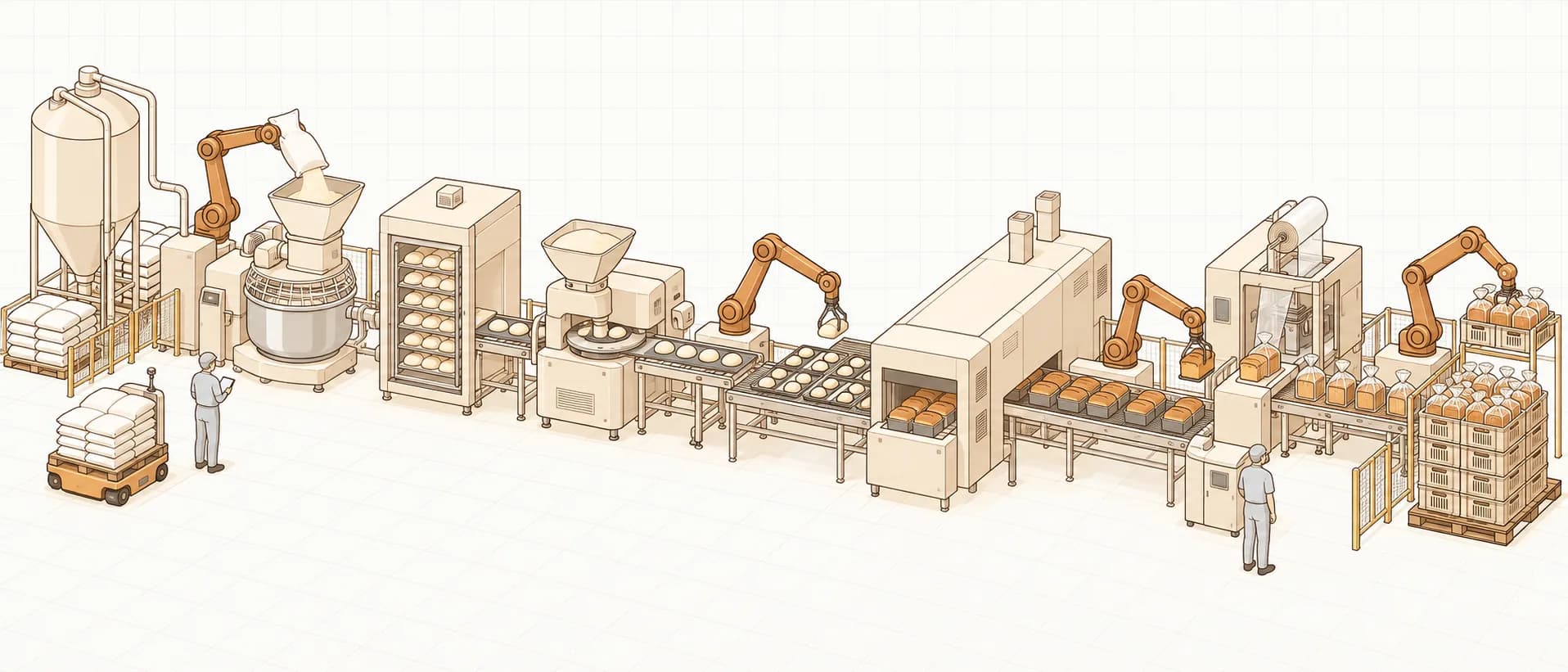
Process flow
Select a step to jump to its tasks.
- 1Receiving1 task
- 2Mixing2 tasks
- 3Bulk fermentation
- 4Dividing
- 5Shaping2 tasks
- 6Baking
- 7Depanning & cooling1 task
- 8Packaging2 tasks
- 9Packing5 tasks
Process sources: 厚生労働省 製パン 職業能力評価基準 関連資料 / 福岡労働局「今月はパン職人」 / 大林組 製パン工場(施設計画)
Tasks by step
For each step, the tasks people do today that robots already handle somewhere. Follow the link to candidate robots and proven deployments.
- Robot-ready
Ingredient receiving & storage
Receive flour, yeast, fats, and sugars. Flour goes to silos; minor ingredients stay in bags and are weighed the day before.
- In use in JapanMoving ingredients from the warehouse to the production areaB-5 Transport, Storage & RetrievalIn-factory Inter-process Transport
Suntory Osaka plant (beverages, adjacent case) × Phoxter: AMRs carry heavy ingredients on routes that never cross forklift traffic (Sep 2025).
Source: LOGISTICS TODAY (2025-09)
- Robot-ready
Weighing & mixing
Mix the ingredients into dough. Opening and tipping bagged ingredients is manual, as is checking dough consistency and temperature.
- Proven overseasDepalletizing 25 kg ingredient bags, opening them, and tipping them into the hopperB-1 Raw Material Feeding & SupplyMaterial Feeding & Machine Tending
BYR automatic bag opener sold by Sojitz Machinery (food-grade, 120 bags/hour depalletizing). AZO (Belgium) feeds 25 kg bags of milk powder to the opener with a sealed robot and AI vision at 95% grasp success.
Source: 双日マシナリー(イプロス) / Siemens(AZO 事例)
- In use in JapanOpening cartons, lifting out inner bags, cutting, tipping, and clearing emptiesB-1 Raw Material Feeding & SupplyMaterial Feeding & Machine Tending
Kirin Beverage (adjacent case) × FANUC: three robots fully automate feeding tea leaves (up to 25 kg), saving 1,870 hours of feeding and 521 hours of weighing a year.
Source: 日本SDA 第31回大会 資料
- Equipment
Bulk fermentation
Ferment the dough in a proofing room at controlled temperature and humidity.
Handled by the fermentation room; there is no handling work.
- Equipment
Dividing, rounding & resting
Divide the dough by weight, round it, and rest it in an intermediate proofer.
Dividers, rounders, and intermediate proofers run at high speed; there is little room for a robot arm.
- Robot-ready
Shaping & tray loading
Shape by hand or machine and place in tins or on trays. Pulling trays and boards and arranging dough are manual.
- Proven overseasPulling trays and boards from racks, laying baking paper, and arranging dough on traysB-1 Raw Material Feeding & SupplyMaterial Feeding & Machine Tending
Malzers (Germany) × ADM Automation: Yaskawa MOTOMAN GP180 (400 trays/hour), MPK2F (paper laying), four MPP3H (placing dough on trays); food-grade grease and washdown paint.
Source: Yaskawa 事例
- Proven overseasUnloading loaded trays from the freezer and stacking them onto rack trolleysB-5 Transport, Storage & RetrievalIn-factory Inter-process Transport
Görtz (Germany) × ADM: four Yaskawa MOTOMAN GP180 FGG with layer grippers, up to six trays at a time, 1,000 trays/hour (running since Nov 2024).
Source: Industrial Production Worldwide
- Equipment
Final proof & baking
Proof the trays in the final proofer and bake in the oven; people decide temperature and time.
Handled by the proofer and oven; settings are decided by people.
- Robot-ready
Depanning & cooling
Remove baked goods from tins and trays and cool them under controlled temperature and humidity.
- Proven overseasLifting baked goods off trays and out of tins (robotic depanner)B-2 Assembly & ProcessingAssembly & Collaborative Work
GEA Robotic depanner: picks directly with needles, suction, or grippers onto the next conveyor; head changes cover loaf bread, croissants, and cakes (product page).
Source: GEA Depanners
- Robot-ready
Slicing & packaging
Slice and bag loaf bread; wrap sweet buns individually. Feeding the wrapper and collating packs are manual.
- Proven overseasPicking products at the oven exit to feed the wrapper, then collating packs into multipacksB-1 Raw Material Feeding & SupplyMaterial Feeding & Machine Tending
ULMA Packaging automated baked-goods line: two articulated robots feed the flow wrapper from the oven exit; another collates packs into the multipack machine.
Source: ULMA Packaging
- In use in JapanAI image inspection of baked goods for shape defects, chips, and foreign matterB-3 Inspection & Quality ControlInspection & Quality Checks
Silvia (doughnut line, adjacent case) × Sensethings Japan ZENAI: inspects 180 pieces a minute, relieving skilled visual inspectors.
Source: AIsmiley
- Robot-ready
Case packing, palletizing & shipping
Pack wrapped goods into crates and cartons, apply date labels, palletize, and ship.
- In use in JapanApplying shipping labels per bread crate, and supplying, discharging, and stacking the cratesB-4 Packing & PalletizingPalletizing & Truck Unloading
Takaki Bakery Tsukuba plant × SATO: a Yaskawa MOTOMAN-HC10 cobot handles four crate types, MOTOMAN-MPP3S applies 3,000 labels/hour; 56 SKUs, about 23,000 items/day, staff 5 → 2, payback 1.8 years.
Source: 経済産業省 ロボット導入実証事業 事例集 (2018)
- Proven overseasPicking bagged loaves and rolls from a moving conveyor into shipping cratesB-4 Packing & PalletizingPalletizing & Truck Unloading
A major Finnish bakery × KINE Robotics: Stäubli TS2-60 SCARA with a ToF 3D camera that sees clear bags; 25–30 bags a minute, previously two workers.
Source: Zebra 事例
- Proven overseasTray-packing baked pastries and case-packing wrapped loavesB-4 Packing & PalletizingPalletizing & Truck Unloading
Dulcesol (Spain): ABB IRB 340 delta robots tray four pastries at a time (100 a minute); an IRB 1600 case-packs seven loaves at once.
Source: ABB 事例 (PDF)
- In use in JapanCase palletizing with a compact cobot palletizerB-4 Packing & PalletizingPalletizing & Truck Unloading
MK Cheese (Kanagawa, adjacent case): two Closer Palletizy units stack 700+ cases a day up to 10 kg; installed in one day.
Source: LOGISTICS TODAY
- Proven overseasMoving finished-goods pallets from the packaging line to the warehouseB-5 Transport, Storage & RetrievalWarehouse Transport
Pimad (a Grupo Bimbo bakery): two ABB stacker AMRs move four pallets per trip, linked to WMS and ERP.
Source: ABB AMR for Food & Beverage
Summary
| Step | Robot-ready task | Stage | Use-case guide |
|---|---|---|---|
| 1. Ingredient receiving & storage | Moving ingredients from the warehouse to the production area | In use in Japan | Transport, Storage & Retrieval |
| 2. Weighing & mixing | Depalletizing 25 kg ingredient bags, opening them, and tipping them into the hopper | Proven overseas | Raw Material Feeding & Supply |
| 2. Weighing & mixing | Opening cartons, lifting out inner bags, cutting, tipping, and clearing empties | In use in Japan | Raw Material Feeding & Supply |
| 5. Shaping & tray loading | Pulling trays and boards from racks, laying baking paper, and arranging dough on trays | Proven overseas | Raw Material Feeding & Supply |
| 5. Shaping & tray loading | Unloading loaded trays from the freezer and stacking them onto rack trolleys | Proven overseas | Transport, Storage & Retrieval |
| 7. Depanning & cooling | Lifting baked goods off trays and out of tins (robotic depanner) | Proven overseas | Assembly & Processing |
| 8. Slicing & packaging | Picking products at the oven exit to feed the wrapper, then collating packs into multipacks | Proven overseas | Raw Material Feeding & Supply |
| 8. Slicing & packaging | AI image inspection of baked goods for shape defects, chips, and foreign matter | In use in Japan | Inspection & Quality Control |
| 9. Case packing, palletizing & shipping | Applying shipping labels per bread crate, and supplying, discharging, and stacking the crates | In use in Japan | Packing & Palletizing |
| 9. Case packing, palletizing & shipping | Picking bagged loaves and rolls from a moving conveyor into shipping crates | Proven overseas | Packing & Palletizing |
| 9. Case packing, palletizing & shipping | Tray-packing baked pastries and case-packing wrapped loaves | Proven overseas | Packing & Palletizing |
| 9. Case packing, palletizing & shipping | Case palletizing with a compact cobot palletizer | In use in Japan | Packing & Palletizing |
| 9. Case packing, palletizing & shipping | Moving finished-goods pallets from the packaging line to the warehouse | Proven overseas | Transport, Storage & Retrieval |
Before you deploy
- Hygiene guideline: comply with MAFF's 2024 guideline on introducing and operating robots in food plants, which sets out HACCP-aligned steps and required features for food-grade robots.
- Food-grade specification: food-grade grease, washdown paint, and sealing. For robots touching dough, confirm the direct/indirect contact class and cleanability.
- Clear bags: bagged bread is hard to locate with 2D cameras; ToF 3D cameras that capture shape have a track record.
- Gripping soft products: choose the hand per product — suction, needles, layer grippers, or soft grippers.
- High mix: bakeries often run 100+ SKUs; automating changeovers, such as sensing crate or tray types, becomes a requirement.
- Main-ingredient feeding is usually out of scope for robots: flour is supplied from silos by pneumatic conveying, so bag feeding applies to minor ingredients.
Discuss where to start in your own process
Bring your process chart and we will map the easiest tasks to replace, candidate robots, and a PoC plan with you.