Garment Factory Cutting-to-Packing Line
Cutting, hanger transport, pressing, and needle detection run on dedicated machines, while singulating cut pieces, feeding sewing machines, main sewing, and folding still rely on people. The big advantage: humanoids and cobots can stand in front of existing sewing and fusing machines in place of a person, so automation starts without replacing equipment.
13 tasks across 4 steps can move to robots.
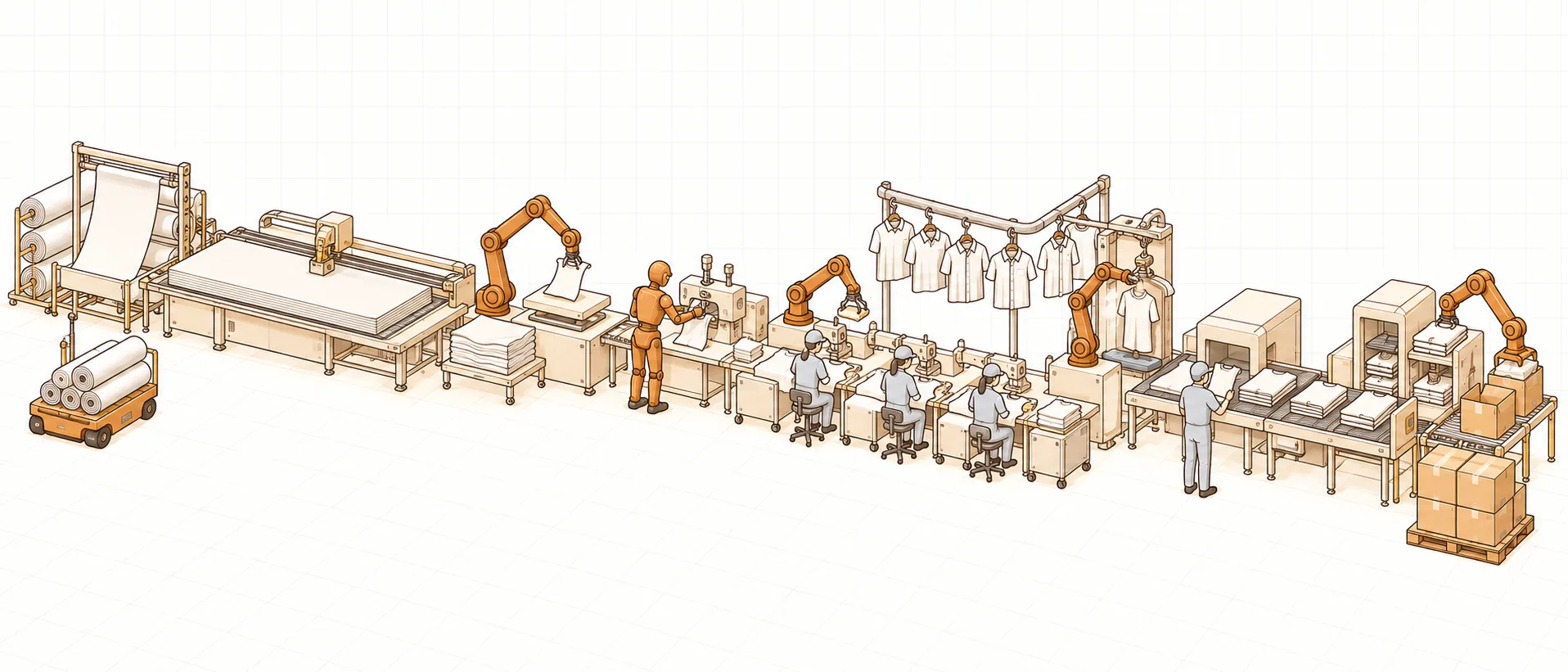
Process flow
Select a step to jump to its tasks.
- 1Receiving1 task
- 2Cutting
- 3Fusing3 tasks
- 4Parts sewing8 tasks
- 5Main sewing
- 6Transport
- 7Pressing
- 8Inspection
- 9Packing1 task
Process sources: 厚生労働省 職業解説 アパレル製造「検反・裁断」 / 厚生労働省 職業解説 アパレル製造「縫製」 / OSHIMA「A Step-by-Step Guide to Garment Production」
Tasks by step
For each step, the tasks people do today that robots already handle somewhere. Follow the link to candidate robots and proven deployments.
- Robot-ready
Fabric receiving & inspection
Receive fabric rolls and inspect them for flaws, weaving defects, and shrinkage on an inspection machine. Moving rolls from storage to the cutting room and loading the cutter is manual.
- Moving fabric rolls in and out of storage, picking them in the warehouse, and feeding/unloading fabric at cutters and sewing machines
Sanmei omnidirectional AMR + cobot for apparel manufacturing: a Yaskawa MOTOMAN-HC10 on a Daihen AiTran (omni-wheels, camera positioning, wireless charging for 24-hour operation), intended for fabric storage in/out and feeding/unloading cutters and sewing machines. No deployment case published.
Source: 三明(イプロス)
- Equipment
Marking, spreading & cutting
Nest patterns in CAD, spread fabric plies tension-free on a spreader, and cut on a CAM cutter. Grain and pattern matching are decided by people.
Handled by automatic spreaders and cutters (Kawakami automates roll loading to spreading and cutting; Shima Seiki P-CAM is installed at Midori Safety's Vietnam plant). No role for a robot arm.
- Robot-ready
Sorting, singulating & fusing cut pieces
Group cut pieces by roll, color, and size, peel them off the stack one at a time, and run them through the fusing press. Singulating plies from the stack relies on human fingertips.
- Picking single plies off a stack of cut pieces and placing them for the next step (sewing or fusing)
Robotextile (Germany) retrofittable flow gripper: air flow lifts only the top ply of knits, non-wovens, or wovens, combined with a patented roller mechanism. C&A uses it for jeans pocket assembly; outdoor brand Vaude is also a user (Texprocess Innovation Award 2026).
Source: Texprocess Innovation Award 2026
- Picking cut pieces and placing them at the fusing press
Aitu (Zhejiang) humanoids are in production trials at garment makers Sunrise Group, Eifini, and Chenfeng Group (Jul 2026), picking and placing cut pieces at fusing presses. For one product category and fabric, 97% ply-separation success and over 98% of sewn output within spec; the company estimates an 18-month payback. Full-flow unmanned operation not yet achieved.
Source: Xinhua (2026-07-24) / 浙江在線 (2026-08-25)
- A robot hand that grips only the top ply of a fabric stack without wrinkling it
TransGP (HKU x Tohoku University): an end-effector with a suction-port roller that rolls up and grips fabric (PCT filed; silver medal, Geneva Inventions 2024). In the fixture-free sewing project, the suction end-effector succeeded in 100 of 100 trials, with seam tracking under 0.1 mm average deviation. No deployments.
Source: HKU Innovation Hub / HKU InnoWing
- Robot-ready
Component sewing (pockets, zippers, template sewing)
Sew components such as pockets, cuffs, and flies on dedicated or template sewing machines. Loading parts, opening/closing and swapping templates, and unloading are manual.
- Aligning the zipper with the jeans fly, sewing it on, and serging the fly edge
JUKI x YKK automatic zipper-setting machine for jeans: robotic sewing arms and automatic fabric transfer align the zipper with the fly, sew it, and serge the edge. A customer's jeans factory adopted it and started production in Oct 2018 (announced Mar 2019).
Source: JUKI ニュース (2019-03-05)
- Moving templates between three template sewing machines
Jack (China, sewing-machine maker) automatic template sewer with a robotic arm developed with Huawei: one arm swaps templates across three machines, and a camera in the head reads the pattern to sew (shown at CISMA 2019). No named deployments.
Source: Apparel Resources CISMA 2019
- Loading and unloading fabric at template sewing machines and pocket setters
Aitu (Zhejiang) humanoids in trials at Sunrise Group, Eifini, and Chenfeng Group (Jul 2026) load and unload fabric at template sewing machines and position material for pocket setters. The company sees 2026-28 as validation of single steps and multi-step coordination scaling in 2028-30.
Source: Xinhua (2026-07-24) / 浙江在線 (2026-08-25)
- Running the template machine end to end: opening/closing templates, stacking fabric, and unloading
NAVIAI from the Zhejiang Humanoid Robotics Innovation Center: Jack Technology ordered 2,000 units (announced May 2026; Siemens as integration partner). R&D began Sep 2024 and the template-machine operation scheme passed PoC in Jul 2025. Requirements: cut-piece alignment within +/-2 mm for collars and pockets, single actions under 10 s. Delivery timing and units in operation unpublished.
Source: humanoid.guide (2026-05) / eWeek (2026-07-29)
- Feeding pockets into a pocket hemming machine and stacking them in order after hemming
Vibemac (jeans automation) modified V700 pocket hemming machine: a robotic arm moves pockets from a four-dock feeding station onto the transport belt, and an unloader stacks hemmed pockets in order on a storage disk (Jan 2019 interview). No named users.
Source: Apparel Resources (2019-01-14)
- Sewing T-shirt components such as sleeves and labels with a vision-guided sewing robot
SoftWear Automation (Atlanta) Sewbot: a four-axis arm with a vacuum gripper moves panels onto the sewing table and micromanipulators guide cloth through the machine. Tianyuan Garments planned 21 lines at one T-shirt per 22 seconds in Arkansas (reported Jan 2018). At the time, Sewbots were producing bath rugs, pillowcases, and towels, with T-shirts still in development; the company now offers on-demand T-shirt production on Sewbots.
Source: IEEE Spectrum (2018-01) / SoftWear Automation
- Turning a hung T-shirt inside out and feeding it into a bottom-hem sewing machine with a dual-arm robot
INESC TEC, University of Porto, and ESI Robotics (Portugal): an ABB YuMi dual-arm robot feeds a sleeveless T-shirt, turned inside out on an automated hanger, into a SiRUBA hemming machine. 98% feeding success (84/86), under 35 s for feeding plus hemming; 76% end-to-end success, with integration into a production cell still future work (ICINCO 2025).
Source: ICINCO 2025 論文
- Temporarily stiffening fabric with a water-soluble polymer so an industrial arm can sew it
Sewbo (Seattle): a UR5 picks PVA-stiffened cut pieces by suction and feeds a consumer sewing machine to sew a complete T-shirt (Sep 2016); the stiffener is rinsed out in hot water afterwards. Not for coated fabrics or leather. No later commercialization confirmed.
Source: FashionUnited (2016-09)
- People
Assembly sewing (main seams)
Join bodies, sleeves, and collars on a divided-labor line. Operators feed fabric by hand, turn pieces inside out, and align curves and notches.
Needs delicate handling such as turning soft fabric and aligning notches, with frequent changeovers across many styles. Existing sewing robots have not reached wide adoption (JUKI, 2015), and Aitu says full-flow unmanned operation is not yet achieved.
- Equipment
Inter-process transport (hanger system)
Hang work-in-progress on hangers and move it between sewing stations on an overhead rail. Hooking and unhooking is manual.
Handled by hanger systems such as INA (China), which has about 1,000 stations in India alone; JUKI offers hangers under Non-Sewing (cutting, transport, finishing). AMRs are at the product stage (Sanmei).
- Equipment
Press finishing
Press finished garments on cuff, pocket, and shirt presses or finishers. Loading the garment is manual.
Handled by shirt finishers and automatic cuff presses (up to 350 pieces/hour). No production-scale robotic arm pressing confirmed.
- Equipment
Inspection & needle detection
Check seams, stains, and flaws by eye and touch, measure dimensions, and run garments through a conveyor needle detector for broken needles and metal.
Needle detection by conveyor detectors (e.g. Sanko Denshi APA series); measurement by camera-based machines (Dongguan Yunji Zhihui, 15 T-shirt dimensions in 6 s per piece). Visual inspection stays manual.
- Robot-ready
Folding, bagging, packing & shipping
Fold garments, tag and bag them, pack cartons, and ship. Loading the folder/bagger and case packing are manual.
- Loading garments into a folding machine, spread flat and without creases
Greif Textile Mietsysteme (Germany, industrial laundry, adjacent case) x sewts VELUM: two FANUC M-10iD robots with a 3D camera find edges and corners and load towels and sheets into folding machines; 500-600 pieces/hour, running since Nov 2022. Garments are the company's next target.
Source: IFR 事例
Summary
| Step | Robot-ready task | Stage | Robot type | Use-case guide |
|---|---|---|---|---|
| 1. Fabric receiving & inspection | Moving fabric rolls in and out of storage, picking them in the warehouse, and feeding/unloading fabric at cutters and sewing machines | Product available | Autonomous Transport RobotRobot Arm | In-plant Transport |
| 3. Sorting, singulating & fusing cut pieces | Picking single plies off a stack of cut pieces and placing them for the next step (sewing or fusing) | Proven overseas | Robot Arm | Raw Material Feeding & Supply |
| 3. Sorting, singulating & fusing cut pieces | Picking cut pieces and placing them at the fusing press | PoC stage | Humanoid | Assembly & Processing |
| 3. Sorting, singulating & fusing cut pieces | A robot hand that grips only the top ply of a fabric stack without wrinkling it | PoC stage | Robot HandRobot Arm | Assembly & Processing |
| 4. Component sewing (pockets, zippers, template sewing) | Aligning the zipper with the jeans fly, sewing it on, and serging the fly edge | In use in Japan | Robot Arm | Assembly & Processing |
| 4. Component sewing (pockets, zippers, template sewing) | Moving templates between three template sewing machines | Product available | Robot Arm | Assembly & Processing |
| 4. Component sewing (pockets, zippers, template sewing) | Loading and unloading fabric at template sewing machines and pocket setters | PoC stage | Humanoid | Assembly & Processing |
| 4. Component sewing (pockets, zippers, template sewing) | Running the template machine end to end: opening/closing templates, stacking fabric, and unloading | PoC stage | Humanoid | Assembly & Processing |
| 4. Component sewing (pockets, zippers, template sewing) | Feeding pockets into a pocket hemming machine and stacking them in order after hemming | Product available | Robot Arm | Raw Material Feeding & Supply |
| 4. Component sewing (pockets, zippers, template sewing) | Sewing T-shirt components such as sleeves and labels with a vision-guided sewing robot | Product available | Robot Arm | Assembly & Processing |
| 4. Component sewing (pockets, zippers, template sewing) | Turning a hung T-shirt inside out and feeding it into a bottom-hem sewing machine with a dual-arm robot | PoC stage | Robot Arm | Raw Material Feeding & Supply |
| 4. Component sewing (pockets, zippers, template sewing) | Temporarily stiffening fabric with a water-soluble polymer so an industrial arm can sew it | PoC stage | Robot Arm | Assembly & Processing |
| 9. Folding, bagging, packing & shipping | Loading garments into a folding machine, spread flat and without creases | Proven overseas | Robot Arm | Raw Material Feeding & Supply |
Before you deploy
- Singulation is the hardest part: lifting only the top ply off a stack needs a gripper method chosen per fabric — air flow, roller, or suction (Robotextile uses four methods, tested on 100+ textiles).
- Success rates vary by style and fabric: Aitu's 97% applies to one product category and one fabric. Run the PoC on a narrowed set of SKUs and fabrics, and exclude materials the method cannot handle (coated fabrics, leather).
- Start with feeding dedicated machines, not free sewing: the track record is robots loading and swapping templates on template sewers, pocket hemmers, and zipper setters. Fixture-free robotic sewing is still research.
- CAM for cutting, hangers for transport come first: spreading and cutting are automated by machines with no robot needed; inter-process transport is dominated by hanger systems, and AMR + cobot is at the product stage (Sanmei).
- Treat humanoids as PoC: even Jack's 2,000-unit order has no published delivery date or units in operation. Validate requirements such as +/-2 mm alignment and sub-10-second actions, and payback (Aitu estimates 18 months), on your own line.
Discuss where to start in your own process
Bring your process chart and we will map the easiest tasks to replace, candidate robots, and a PoC plan with you.