Vehicle Production Line at an Assembly Plant
Welding and painting are robotized as standard, but receiving, parts supply, trim, final inspection, and shipping still rely on people. Here is what robots can take over at each step, from Japanese automakers' public plant tours and overseas trials.
9 of 9 steps have robot-ready tasks (20 in total).
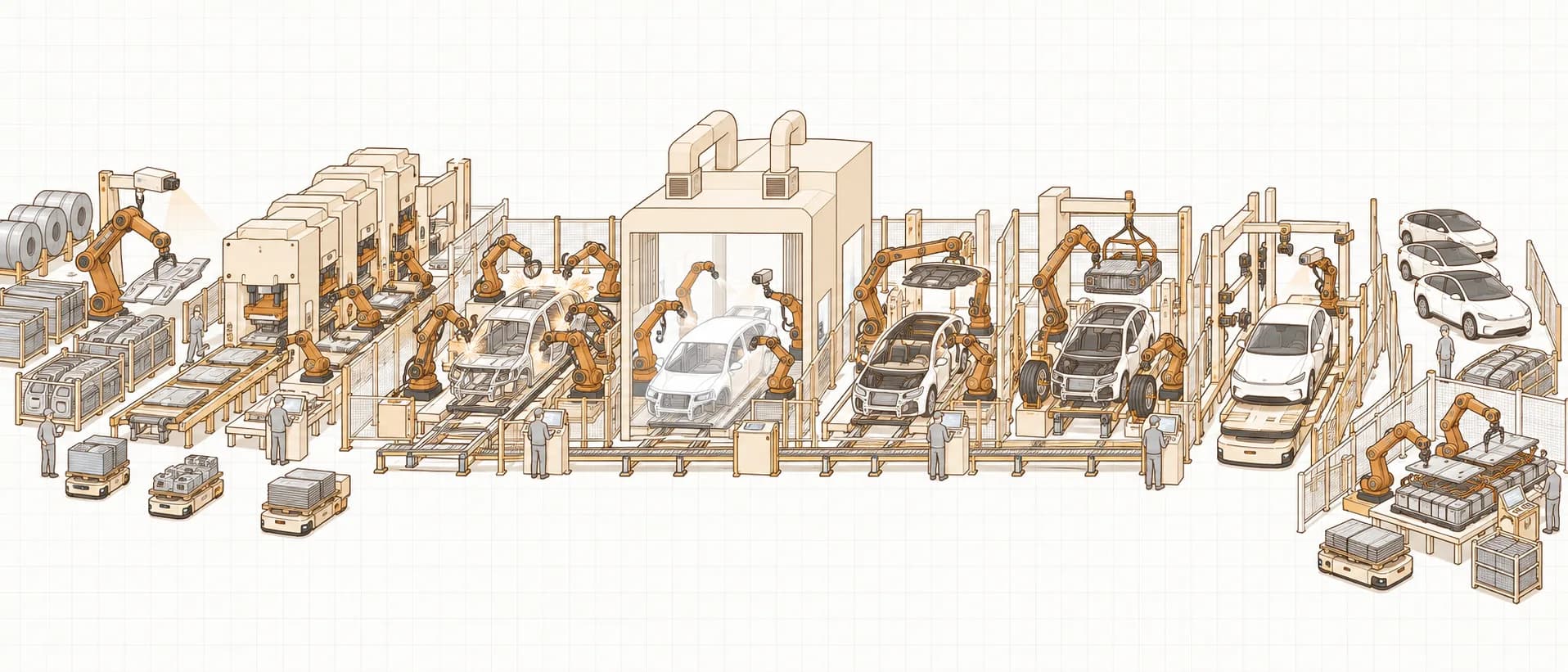
Process flow
Select a step to jump to its tasks.
- 1Receiving3 tasks
- 2Stamping1 task
- 3Body welding2 tasks
- 4Painting1 task
- 5Trim: interior3 tasks
- 6Trim: chassis4 tasks
- 7Final inspection2 tasks
- 8Shipping2 tasks
- 9EV battery2 tasks
Process sources: トヨタ バーチャル工場見学 / Honda クルマができるまで / 日産 工場見学・クルマができるまで
Tasks by step
For each step, the tasks people do today that robots already handle somewhere. Follow the link to candidate robots and proven deployments.
- Robot-ready
Parts & steel receiving
Receive steel coils and parts from 100+ suppliers, unload returnable containers, sort them, and supply each shop.
- In use in JapanDepalletizing mixed returnable containers and sorting inbound partsB-5 Transport, Storage & RetrievalPicking
Matsuda Electric (Aichi, automotive electrical parts) × Mujin: two 3D-vision depalletizing robots handle containers of varying shapes and stacking; 3 staff → 0, about 5,000 boxes/day (Sep 2026).
Source: LOGISTICS TODAY (2026-09)
- PoC stagePicking parts from inbound containers and sequencing them onto line-side trolleysB-5 Transport, Storage & RetrievalPicking
BMW Spartanburg (US): Figure 03 sorts loose parts onto sequencing trolleys, delivered to the line by AGV (announced Jun 2026, early stage). At Hyundai Metaplant America, Boston Dynamics Atlas is being tested on parts sorting.
Source: BMW Group PressClub (2026-06) / Interesting Engineering (2026-09)
- In use in JapanMoving parts between receiving, picking, and processing areasB-5 Transport, Storage & RetrievalIn-factory Inter-process Transport
Toyota: 400+ Geek+ transport AMRs across several plants (up to ~200 per system), separating robot traffic from forklifts and logging parts movement (Jun 2026).
Source: LNEWS (2026-06-10)
- Robot-ready
Stamping
Uncoil and blank the steel, form body panels and structural parts in a four-stage press line, then sequence them for the next shop.
- In use in JapanTransferring panels between pressesB-1 Raw Material Feeding & SupplyMaterial Feeding & Machine Tending
Press-to-press transfer robots such as the ABB IRB 760PT (450 kg payload, 3.18 m reach) are standard on automotive press lines; Honda automates sheet loading, pressing, and unloading.
Source: MONOist (2020-10-27) / Honda プレス工程
- Robot-ready
Body welding
Join floor, sides, and roof with about 4,000 spot welds; fit doors, hood, and trunk lid; inspect at each station.
- PoC stageLoading sheet-metal parts into welding fixtures (still manual today)B-2 Assembly & ProcessingHumanoid Factory PoCs
BMW Spartanburg body shop: Figure 02 inserts sheet-metal parts into welding fixtures; ran about 11 months supporting production of 30,000+ X3s (Jun 2026).
Source: BMW Group PressClub (2024-08) / BMW Group PressClub (2026-06)
- Proven overseasVisual quality inspection of welded bodiesB-3 Inspection & Quality ControlInspection & Quality Checks
Hyundai Metaplant America (Georgia, US): Boston Dynamics Spot performs visual inspection in the weld shop (opened Mar 2025).
Source: Hyundai Motor Group (2025-03)
- Robot-ready
Painting
Cleaning, e-coat, sealer, primer, topcoat, and bake. Topcoat is robotic, sealer is shared with people, and paint inspection is by eye and touch.
- In use in JapanPaint-surface inspection for dirt, nibs, and craters, plus color, film-thickness, and gloss measurementB-3 Inspection & Quality ControlInspection & Quality Checks
Nissan Tochigi plant (Ariya): multiple camera robots with zebra lighting inspect the body in about 600 zones, detecting 0.3 mm dirt; defects go to inspectors' phones for manual repair.
Source: 日産 栃木工場 STORIES 05
- Robot-ready
Trim & final assembly (interior, electrical)
Remove the doors, then fit the wiring harness, headliner, and instrument panel — about 3,000 parts in order along a 1 km line.
- In use in JapanFitting the headliner with clipsB-2 Assembly & ProcessingAssembly & Collaborative Work
Nissan Tochigi plant: measures clip-hole positions, aligns the soft headliner, and confirms fit from press-in vibration and pressure (introduced 2020).
Source: 日産 栃木工場 STORIES 04
- In use in JapanInstalling the instrument panel and electrical units, and plugging grommetsB-2 Assembly & ProcessingAssembly & Collaborative Work
Honda Yorii plant (Saitama): instrument-panel robots from launch; electrical-unit fitting and grommets robotized in 2015.
Source: ニュースイッチ (2016-03-27)
- PoC stageDelivering parts kits to the line and feeding small partsB-2 Assembly & ProcessingHumanoid Factory PoCs
Mercedes-Benz (Hungary, Berlin): Apptronik Apollo starts with parts-kit delivery. At a Xiaomi plant, humanoids feed nuts and handle bins (Mar 2026).
Source: Apptronik (2024-03) / China Daily (2026-04)
- Robot-ready
Trim & final assembly (powertrain, chassis, exterior)
Marry the engine or motor and suspension from below, fit wheels, glass, and seats, and refit the doors.
- In use in JapanMarrying motor, battery, and rear suspension in one lift, with upward bolt tighteningB-2 Assembly & ProcessingAssembly & Collaborative Work
Nissan Tochigi SUMO: high-speed vision tracks the body in real time while robots marry the unit and tighten upward bolts; 6 stations → 1, mixed gasoline/e-POWER/EV.
Source: 日産 栃木工場 STORIES 04
- In use in JapanWheel fitting with bolt tightening, and seat installationB-2 Assembly & ProcessingAssembly & Collaborative Work
Honda: LED sensors locate bolt holes and four robots fit wheels and tighten bolts; seats are placed one at a time along a path that avoids scratching the body.
Source: Honda 車体組立工程
- In use in JapanMoving parts between stations by AGV and driverless tugsB-5 Transport, Storage & RetrievalIn-factory Inter-process Transport
Toyota Motomachi machining: about 100 under-cart AGVs with position tracking. Toyota Burnaston (UK): driverless tug AGVs tow dolly trains of resin tailgates.
Source: 日立ソリューションズ 導入事例 / MasterMover 事例
- PoC stageHumanoids fitting parts on the assembly lineB-2 Assembly & ProcessingHumanoid Factory PoCs
UBTech Walker S1 sorts, moves, and fits parts at BYD and Zeekr; XPeng runs 500+ Iron units in its own plant (company claims, tasks not disclosed).
- Robot-ready
Final inspection
Certified inspectors check about 1,500 items: parts verification, visual and tactile checks, headlamp aim, roller tests, and a test-track drive.
- Proven overseasIn-line gap-and-flush measurementB-3 Inspection & Quality ControlInspection & Quality Checks
Stellantis: a Comau RACER-5 cobot with vision measures 50+ points on hoods, doors, and tailgates on the moving final-assembly conveyor; 60+ vehicles/hour, repeatability in the 0.1 mm range.
Source: Comau
- PoC stageFunction checks of door locks, seat belts, and headlamp covers; badge applicationB-2 Assembly & ProcessingHumanoid Factory PoCs
UBTech Walker S does quality checks and badge application at Nio's F2 plant (Feb 2024); Dongfeng Liuzhou plans 20 units (Mar 2025); air-conditioner leak tests at Audi Changchun.
Source: CnEVPost (2024-08) / China Daily HK (2025-05)
- Robot-ready
Shipping
Move finished vehicles to the yard, line them up by destination, and load them onto car carriers and ships.
- In use in JapanMoving vehicles within the finished-car yard (replacing drivers' 8 km of daily walking back)B-5 Transport, Storage & RetrievalBack-of-house & Campus Transport
Toyota Motomachi VLR: slides under the vehicle, lifts all four wheels, navigates by RTK-GNSS, fleet-managed (in service since Sep 2023).
Source: 自動運転ラボ (2023-09) / MONOist (2023-09-20)
- In use in JapanDriverless towing of finished vehicles from plant to wharfB-5 Transport, Storage & RetrievalBack-of-house & Campus Transport
Nissan Oppama plant: a LEAF-based autonomous tow vehicle hauls up to three cars over 1.4 km (since Dec 2016).
Source: 日産 ニュースリリース (2016-12-05)
- Robot-ready
Sub-line: EV battery pack assembly
Align, test, and stack cells into modules; weld, bond, and bolt them into the case; build the pack and feed it to the vehicle line.
- Proven overseasFrom cell testing, stacking, and welding to module assembly and end-of-line testingB-2 Assembly & ProcessingAssembly & Collaborative Work
Comau delivered five module lines for ACC (Stellantis/Mercedes/TotalEnergies JV). Ford Cologne runs a 2 km pack-assembly line with 180 robots (production since Jun 2025).
Source: Automation World (2022-10) / Ford (2025-06)
- PoC stageManual work in high-voltage battery assembly, such as supplying cells and modulesB-2 Assembly & ProcessingHumanoid Factory PoCs
BMW Leipzig is testing Hexagon Robotics AEON in high-voltage battery assembly and parts production (first run Dec 2025, pilot summer 2026).
Source: Automotive World (2026-03)
Summary
| Step | Robot-ready task | Stage | Use-case guide |
|---|---|---|---|
| 1. Parts & steel receiving | Depalletizing mixed returnable containers and sorting inbound parts | In use in Japan | Transport, Storage & Retrieval |
| 1. Parts & steel receiving | Picking parts from inbound containers and sequencing them onto line-side trolleys | PoC stage | Transport, Storage & Retrieval |
| 1. Parts & steel receiving | Moving parts between receiving, picking, and processing areas | In use in Japan | Transport, Storage & Retrieval |
| 2. Stamping | Transferring panels between presses | In use in Japan | Raw Material Feeding & Supply |
| 3. Body welding | Loading sheet-metal parts into welding fixtures (still manual today) | PoC stage | Raw Material Feeding & Supply |
| 3. Body welding | Visual quality inspection of welded bodies | Proven overseas | Inspection & Quality Control |
| 4. Painting | Paint-surface inspection for dirt, nibs, and craters, plus color, film-thickness, and gloss measurement | In use in Japan | Inspection & Quality Control |
| 5. Trim & final assembly (interior, electrical) | Fitting the headliner with clips | In use in Japan | Assembly & Processing |
| 5. Trim & final assembly (interior, electrical) | Installing the instrument panel and electrical units, and plugging grommets | In use in Japan | Assembly & Processing |
| 5. Trim & final assembly (interior, electrical) | Delivering parts kits to the line and feeding small parts | PoC stage | Raw Material Feeding & Supply |
| 6. Trim & final assembly (powertrain, chassis, exterior) | Marrying motor, battery, and rear suspension in one lift, with upward bolt tightening | In use in Japan | Assembly & Processing |
| 6. Trim & final assembly (powertrain, chassis, exterior) | Wheel fitting with bolt tightening, and seat installation | In use in Japan | Assembly & Processing |
| 6. Trim & final assembly (powertrain, chassis, exterior) | Moving parts between stations by AGV and driverless tugs | In use in Japan | Transport, Storage & Retrieval |
| 6. Trim & final assembly (powertrain, chassis, exterior) | Humanoids fitting parts on the assembly line | PoC stage | Assembly & Processing |
| 7. Final inspection | In-line gap-and-flush measurement | Proven overseas | Inspection & Quality Control |
| 7. Final inspection | Function checks of door locks, seat belts, and headlamp covers; badge application | PoC stage | Inspection & Quality Control |
| 8. Shipping | Moving vehicles within the finished-car yard (replacing drivers' 8 km of daily walking back) | In use in Japan | Transport, Storage & Retrieval |
| 8. Shipping | Driverless towing of finished vehicles from plant to wharf | In use in Japan | Transport, Storage & Retrieval |
| 9. Sub-line: EV battery pack assembly | From cell testing, stacking, and welding to module assembly and end-of-line testing | Proven overseas | Assembly & Processing |
| 9. Sub-line: EV battery pack assembly | Manual work in high-voltage battery assembly, such as supplying cells and modules | PoC stage | Raw Material Feeding & Supply |
Before you deploy
- Treat all humanoid cases as PoCs: apart from BMW's Figure 02 (11 months supporting production), most are a few units or company claims. No confirmed deployment at a Japanese assembly plant yet.
- Final inspection is regulated: AI inspection equipment must meet MLIT criteria (accuracy equal to certified inspectors, automatic stop and logging, a responsible manager) and be registered.
- Flexible parts and position variance: the headliner (Nissan), door fit (Mazda), and mixed containers (Mujin) were all solved with vision measurement plus fit verification — plan the sensors together with the robot.
- Mixed-model lines: gasoline, HEV, and EV run on the same line; confirm the robot can switch recipes by teaching alone.
- Few public Japanese cases on EV battery sub-lines; cite overseas references (Ford Cologne, ACC/Comau).
Discuss where to start in your own process
Bring your process chart and we will map the easiest tasks to replace, candidate robots, and a PoC plan with you.