SMT Board Assembly to Final Product Line
Printing, placement, and reflow are already automated, but reel setup, odd-form insertion, connector mating, test-fixture loading, and packing still rely on people. Here is what robots can take over at each step, from placement-machine makers and cobot deployments.
8 of 9 steps have robot-ready tasks (16 in total).
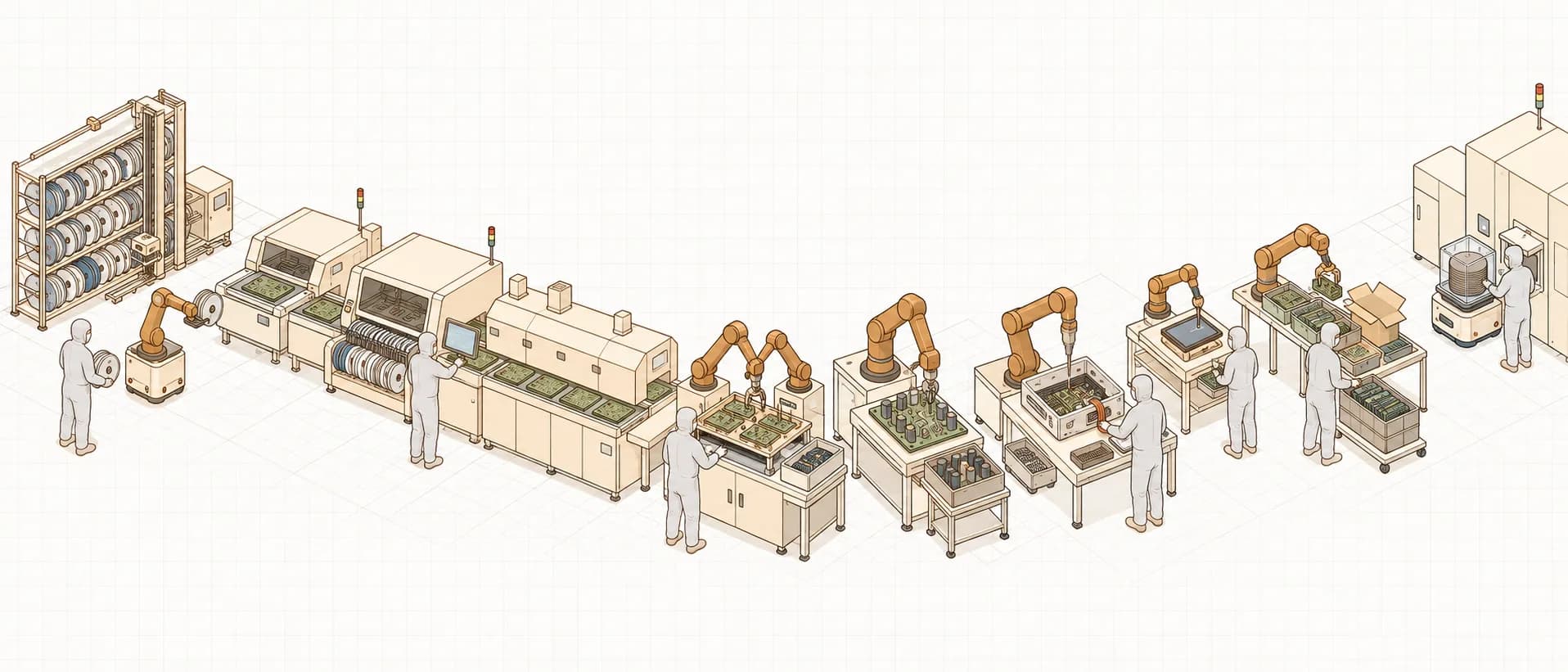
Process flow
Select a step to jump to its tasks.
- 1Receiving1 task
- 2Supply3 tasks
- 3Placement
- 4Board inspection1 task
- 5Insertion2 tasks
- 6Assembly3 tasks
- 7FCT1 task
- 8Packing & shipping2 tasks
- 9FOUP3 tasks
Process sources: 電波新聞デジタル「実装機動向」(2025-06) / サンテクノロジー SMTライン / マイナビ OKIテクノパワーシステムズ 工場レポート
Tasks by step
For each step, the tasks people do today that robots already handle somewhere. Follow the link to candidate robots and proven deployments.
- Robot-ready
Material receiving & storage
Inspect and register reels, trays, and board magazines, then move them in and out of racks or automated storage.
- Product availableAutomate feeder and reel storage, issuing what each build needs from the production planB-5 Transport, Storage & RetrievalWarehouse Transport
FUJI Smart Storage (unveiled at JISSO PROTEC 2025), linked with AMRs, automated storage, and production software.
Source: 電波新聞デジタル (2025-06-04) / MONOist (2026-06-18)
- Robot-ready
Component supply & feeder setup
Load reels into feeders and carry cassettes or magazines to the placement machine for changeover.
- PoC stageLoading tape reels into feeders: removing empties, reading IDs, preparing tape, and loadingB-1 Raw Material Feeding & SupplyMaterial Feeding & Machine Tending
FUJI Auto Kitting Station (announced May 2026, first shown at JISSO PROTEC 2026); handles 8 mm tape components.
Source: MONOist (2026-06-18) / LOGI-TODAY
- Proven overseasDelivering component magazines to the placement machine by AMR and swapping out emptiesB-1 Raw Material Feeding & SupplyMaterial Feeding & Machine Tending
FUJI × Standard Robots (Shenzhen): Oasis-300E AMR feeding the NXTR A placement machine; verified at a customer site, Japan rollout in preparation (Aug 2025).
Source: LOGI-TODAY (2025-08-25)
- PoC stageUnattended feeder-cassette changeover and AMR delivery of setup items such as metal masksB-1 Raw Material Feeding & SupplyMaterial Feeding & Machine Tending
Yamaha Motor Change Loader AMR (concept, JISSO PROTEC 2024); Panasonic Connect multi-purpose AMR (concept, JISSO PROTEC 2023).
Source: MONOist (2024-06-18) / MONOist (2023-06-13)
- Equipment
Solder printing, placement & reflow
Printer, placement machine, and reflow oven run automatically; people handle mask changes, stock-outs, and error recovery.
Already automated by dedicated equipment; the remaining manual work (setup and replenishment) is covered in step 2.
- Robot-ready
Inspection (SPI / AOI / AXI / ICT)
SPI, AOI, and X-ray run automatically; for ICT, a person sets each board in a fixture.
- In use in JapanLoading high-mix boards into existing testers and fixtures, judging pass/fail by image, and sortingB-3 Inspection & Quality ControlInspection & Quality Checks
Panasonic Kobe plant (2019): dual-arm robot automates board testing using the existing testers and fixtures, with no wiring, so it can be relocated.
Source: MONOist (2019-07-19)
- Robot-ready
Through-hole insertion & hand soldering
People insert large or odd-form leaded parts and run the board through wave solder; large parts are hand-soldered.
- Product availableInserting large and odd-form leaded parts (electrolytic capacitors, coils) and driving screwsB-2 Assembly & ProcessingAssembly & Collaborative Work
JUKI JM-E01 (on sale Dec 2024, parts up to 90 mm tall); FUJI sFAB-D and SmartWing BA (JISSO PROTEC 2024).
Source: JUKI ニュースリリース / 電波新聞デジタル (2024-06-12)
- Product availableReplacing hand soldering of large parts after reflow with a soldering robotB-2 Assembly & ProcessingAssembly & Collaborative Work
Laser and ultrasonic soldering robots from several Japanese makers (no named customer sites in the source).
Source: 電波新聞デジタル (2022-11-25)
- Robot-ready
Depaneling & enclosure assembly
Depanel boards, fit them into the enclosure, drive screws, and mate FPC/FFC cables to connectors.
- Product availableInserting thin, flexible FPC/FFC cables into connectorsB-2 Assembly & ProcessingAssembly & Collaborative Work
Sintokogio FPC auto-insertion system (force sensor detects 0.5 g changes, Dec 2023); Nachi connector-insertion application (stereo camera, connectors 5–41 mm wide).
Source: MONOist (2023-12-28) / MONOist (2021-11-25)
- Product availablePrecision screwdriving and inserting HDDs or memory into server chassisB-2 Assembly & ProcessingAssembly & Collaborative Work
Two Mitsubishi Electric MELFA arms with force sensors hold an FPC and drive screws; MELFA inserts HDDs by feel. HIOS electric screwdriver on a UR5e (UR+ certified).
Source: 三菱電機 FA 精密ねじ締め / 三菱電機 FA サーバ組立 / MONOist (2023-02-08)
- PoC stageHumanoids working on a tablet mass-production lineB-2 Assembly & ProcessingHumanoid Factory PoCs
AGIBOT G2 at Longcheer Technology (Chinese ODM), announced Apr 2026: 19–20 s cycle, 310 units/hour. Company announcement only; tasks not disclosed.
Source: innovatopia (2026-04-16)
- Robot-ready
Functional test (FCT)
Power up the assembled product and test operation and touch panels; loading fixtures and judging results are manual.
- In use in JapanTouch-panel testing by pressing with a stylus and checking the responseB-3 Inspection & Quality ControlInspection & Quality Checks
Koyo Electronics (automotive electronics and PLCs), UR3: productivity +31%, post-inspection staff 2→1, payback about one year.
Source: Universal Robots 導入事例
- Robot-ready
Packing & shipping
Pack boards and products into trays and boxes, then move them to the shipping area.
- Proven overseasPlacing small boards into trays and trays into boxesB-4 Packing & PalletizingPacking & Palletizing
Melecs EWS (Austria), UR5 with a custom gripper: three boards at a time into 54-board trays, 2 million boards a year, productivity +25%, 18-month payback.
Source: Universal Robots 導入事例
- In use in JapanMoving finished goods to the shipping area by AMRB-5 Transport, Storage & RetrievalIn-factory Inter-process Transport
OMRON Ayabe plant (Kyoto): nine AMRs plant-wide, three for shipping and one for mask magazines, dispatched by MES to the nearest free unit.
Source: MONOist (2023-08-14)
- Robot-ready
Semiconductor front-end: FOUP transport
Carry 25-wafer FOUPs to tool load ports. Overhead transport (OHT) is standard in 300 mm fabs, but carts and people remain in older fabs and back-end plants.
- In use in JapanReplacing cart transport of wafer boxes with AMRs and cobotsB-5 Transport, Storage & RetrievalIn-factory Inter-process Transport
ROHM Device Manufacturing Hamamatsu plant: Adept AMRs and three cobots hand boxes through pass boxes and upper-floor sliders; lead time 60→42 days.
Source: ニュースイッチ (2026-07-01)
- In use in JapanMoving material and part containers between cleanroom areasB-5 Transport, Storage & RetrievalIn-factory Inter-process Transport
REALIZE WILL-FA AMRs for the Rapidus IIM-1 fab (Chitose, Hokkaido), announced Aug 2024.
Source: LOGI-TODAY (2024-08-27)
- PoC stageMobile manipulator moving FOUPs between load portsB-5 Transport, Storage & RetrievalIn-factory Inter-process Transport
KUKA KMR iisy cleanroom version (ISO 3 certified, ESD compliant), demonstrated at SEMICON West 2024.
Source: Novus Light (2024)
Summary
| Step | Robot-ready task | Stage | Use-case guide |
|---|---|---|---|
| 1. Material receiving & storage | Automate feeder and reel storage, issuing what each build needs from the production plan | Product available | Transport, Storage & Retrieval |
| 2. Component supply & feeder setup | Loading tape reels into feeders: removing empties, reading IDs, preparing tape, and loading | PoC stage | Raw Material Feeding & Supply |
| 2. Component supply & feeder setup | Delivering component magazines to the placement machine by AMR and swapping out empties | Proven overseas | Raw Material Feeding & Supply |
| 2. Component supply & feeder setup | Unattended feeder-cassette changeover and AMR delivery of setup items such as metal masks | PoC stage | Raw Material Feeding & Supply |
| 4. Inspection (SPI / AOI / AXI / ICT) | Loading high-mix boards into existing testers and fixtures, judging pass/fail by image, and sorting | In use in Japan | Inspection & Quality Control |
| 5. Through-hole insertion & hand soldering | Inserting large and odd-form leaded parts (electrolytic capacitors, coils) and driving screws | Product available | Assembly & Processing |
| 5. Through-hole insertion & hand soldering | Replacing hand soldering of large parts after reflow with a soldering robot | Product available | Assembly & Processing |
| 6. Depaneling & enclosure assembly | Inserting thin, flexible FPC/FFC cables into connectors | Product available | Assembly & Processing |
| 6. Depaneling & enclosure assembly | Precision screwdriving and inserting HDDs or memory into server chassis | Product available | Assembly & Processing |
| 6. Depaneling & enclosure assembly | Humanoids working on a tablet mass-production line | PoC stage | Assembly & Processing |
| 7. Functional test (FCT) | Touch-panel testing by pressing with a stylus and checking the response | In use in Japan | Inspection & Quality Control |
| 8. Packing & shipping | Placing small boards into trays and trays into boxes | Proven overseas | Packing & Palletizing |
| 8. Packing & shipping | Moving finished goods to the shipping area by AMR | In use in Japan | Transport, Storage & Retrieval |
| 9. Semiconductor front-end: FOUP transport | Replacing cart transport of wafer boxes with AMRs and cobots | In use in Japan | Transport, Storage & Retrieval |
| 9. Semiconductor front-end: FOUP transport | Moving material and part containers between cleanroom areas | In use in Japan | Transport, Storage & Retrieval |
| 9. Semiconductor front-end: FOUP transport | Mobile manipulator moving FOUPs between load ports | PoC stage | Transport, Storage & Retrieval |
Before you deploy
- ESD: match potentials across the robot body, end-effector materials, and grounding; pick models with ESD variants.
- Cleanliness: front-end fabs are ISO class 3; check cleanroom certification and particle generation from belts and plastics.
- Placement-machine ecosystems: automatic feeder changeover and magazine delivery are tied to each maker; confirm compatibility with existing machines from other vendors.
- Packaging and size limits: reel loading automation covers a limited range (e.g., 8 mm tape); check height and weight limits for odd-form parts.
- Force sensing: FPC insertion, screwdriving, and HDD insertion usually need force control.
Discuss where to start in your own process
Bring your process chart and we will map the easiest tasks to replace, candidate robots, and a PoC plan with you.